The second volume Gefilte film is an inevitable continuation and consequence of the first, in which Joanna Preizner and the authors invited by her presented mainly films showing the life of Jews before the Holocaust. In the second volume, analyses of images devoted to the Holocaust appear in the lead, which I think was inevitable, because – as the author of this choice says – „In the collective consciousness, Jews exist first by their death, and only then by life …”.
Reading both volumes, it is impossible not to be amazed at how deeply world cinema is interested in the fate of Jews and how faithfully it shows it on the screen.
I am proud that I also participate in this phenomenon with several of my films.
Andrzej Wajda
*
Gefilte film II. Jewish Themes in Cinema is another volume (the first one was published in 2008 by the Szolem Alejchem publishing house) in a series devoted to films that tell about Jews, their customs and rich, unusual culture – as well as about the Holocaust. In the previous volume, it was possible to maintain a balance between texts devoted to Jewish life before the Holocaust and those that tell about it. In the second part, it is disrupted in favour of images showing the Holocaust. There are simply more such films, as if in the collective consciousness Jews existed first by their death, and only then by life…
The authors of the texts published here analyse the works made by artists who are not Jews or despite their Jewish origin, who do not live every day in the circle of traditions and religion of their ancestors. Thus, their gaze is, therefore, the gaze of someone from the outside, from a distance. They are determined by many factors – the place and time of the film’s creation, the historical and political context, the mentality of the inhabitants of a given country. In Gefilte film II there are texts devoted to Polish and foreign works, documentary and fictional, pre-war, and created only a few years ago. Their authors are film experts from Polish scientific centres – professors, associate professors, as well as Doctors of Philosophy and doctoral students.
*
They were here. They lived next to Poles for centuries – more often „next door” than „together” with them. Men wore traditional huts, married women wigs, young men studied the Talmud, boys in cheders read the Gemara. The girls learned how to be a good wife and mother, and children played in the yards.
On Friday evening, Shabbat candles shone in the Jewish windows. They ate strange dishes: gefilte fish, Cholent and Kugel, but Bagels with roasted onions sold on the streets tasted to both Jews and Poles.
They were here. They had their own world – mysterious, closed, alien. They aroused emotions – various. By building their culture, they brought so much to Polish one.
And then came the Holocaust. And there were no more men in huts or women in wigs on the streets, and the windows of their homes on Friday evenings remained dark.
This book is a stone put on a Matzevah. But also, a brick for the construction of a new world, in which there will be no „next door” – it will be „together”.
Joanna Preizner (from the introduction)
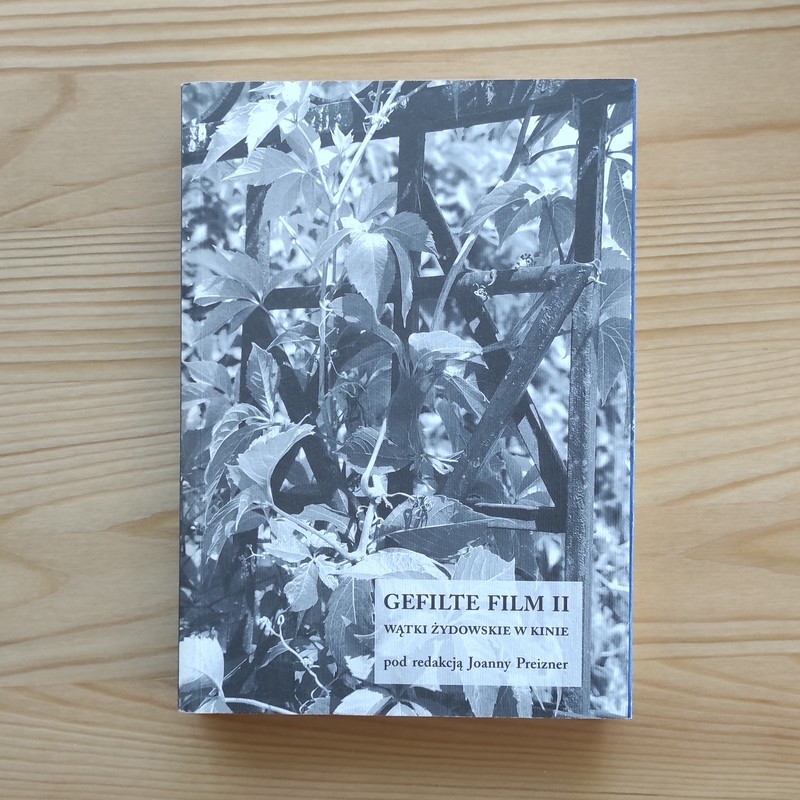
Gefilte film II. Wątki żydowskie w kinie, 2009
Tom drugi Gefilte film jest nieuniknioną kontynuacją i konsekwencją pierwszego, w którym Joanna Preizner i zaproszeni przez Nią Autorzy przedstawili głównie filmy pokazujące życie Żydów przed Zagładą. W tomie drugim w przewadze pojawiają się analizy obrazów poświęconych Zagładzie, co było, jak myślę, nieuniknione, gdyż – jak mówi Autorka tego wyboru – „W świadomości zbiorowej Żydzi istnieją najpierw przez swoją śmierć, a dopiero potem przez życie…”.
Czytając oba tomy nie sposób nie zdumieć się, jak głęboko kino światowe interesuje się losami Żydów i jak wiernie ukazuje je na ekranie.
Jestem dumny, że i ja kilkoma moimi filmami uczestniczę w tym zjawisku.
Andrzej Wajda
*
Gefilte film II. Wątki żydowskie w kinie jest kolejnym tomem (pierwszy ukazał się w 2008 roku nakładem wydawnictwa Szolem Alejchem) w serii poświęconej filmom, które opowiadają o Żydach, ich obyczajowości i bogatej, niezwykłej kulturze – a także o ich Zagładzie. W poprzednim tomie udało się zachować równowagę pomiędzy tekstami poświęconymi życiu żydowskiemu przed Holokaustem a tymi, które o nim opowiadają. W drugiej części jest ona zaburzona na korzyść obrazów pokazujących Zagładę. Takich filmów jest po prostu więcej, jakby w zbiorowej świadomości Żydzi istnieli najpierw przez swoją śmierć, a dopiero potem przez życie…
Autorzy zamieszczonych tu tekstów analizują dzieła zrealizowane przez twórców niebędących Żydami lub mimo żydowskiego pochodzenia nieżyjących na co dzień w kręgu tradycji i religii swoich przodków. Ich spojrzenie jest więc siłą rzeczy spojrzeniem kogoś z zewnątrz, z dystansu. Determinuje je wiele czynników – miejsce i czas powstania filmu, kontekst historyczny i polityczny, mentalność mieszkańców danego kraju. W Gefilte film II znajdują się teksty poświęcone dziełom polskim i zagranicznym, dokumentalnym i fabularnym, przedwojennym i powstałym zaledwie kilka lat temu. Ich autorami są filmoznawcy z polskich ośrodków naukowych – profesorowie, doktorzy habilitowani, a także doktorzy i doktoranci.
*
Byli tutaj. Obok Polaków mieszkali przez stulecia – częściej „obok” niż „razem” z nimi. Mężczyźni nosili tradycyjne chałaty, zamężne kobiety peruki, młodzieńcy studiowali Talmud, chłopcy w chederach czytali Gemarę. Dziewczęta uczyły się, jak być dobrą żoną i matką, a na podwórkach bawiły się dzieci.
W piątkowy wieczór w oknach żydowskich błyszczały szabasowe świece. Jedli dziwne potrawy: gefilte fisz, czulent i kugel, ale sprzedawane na ulicach bajgle z prażoną cebulką smakowały zarówno Żydom, jak i Polakom.
Byli tutaj. Mieli swój świat – tajemniczy, zamknięty, obcy. Budzili emocje – najróżniejsze. Budując swoją kulturę, tak wiele wnieśli do polskiej.
A potem przyszła Zagłada. I nie było już na ulicach mężczyzn w chałatach, ani kobiet w perukach, a w oknach ich domów w piątkowe wieczory pozostały ciemne.
Ta książka to kamyk położony na macewie. Ale także cegła pod budowę nowego świata, w którym nie będzie „obok” – będzie „razem”.
Joanna Preizner (from the introduction)