(Translation, edition and footnotes by Joanna Preizner)
Reading The Life of Jews in Poland before the Holocaust: A Memoir of Ben-Zion Gold, I simply cannot believe that these events took place in Radom, the city where I lived at that time. It is true, the Author is a bit older than me, but his world does not touch mine at any point – neither in school, nor in church, nor in scouting. Even the described streets are known to me only by name. More importantly, this world is extremely serious, and the considerations and choices of this teenage Jewish boy are those of an adult male…
Andrzej Wajda (from the introduction)
*
Ben-Zion Gold’s memoir brings to life the world of a million Jews in pre-World War II Poland who were later destroyed by the Nazis. Warmly recalling the relationships, rituals, observances, and celebrations, Gold evokes the sense of family and faith that helped him through the catastrophe that followed. With him we experience the life and institutions of the time: the Heder and hooky playing, his encounter with Hassidism, the courtship and marriage of his oldest sister, and the author’s own first inkling of love. And with him, we recapture the memories that made life worth living in the face of disaster, along with the experience of the human capacity for evil that tested and transformed his faith as it devastated his world. Finally, Gold tells of the fate of his family and of his own escape from that fate.
*
„Rabbi Gold writes with a rare combination of insight and understanding; the result is a fascinating, instructive and uniquely intimate memoir.”–Ruth Anna Putnam, professor emerita of philosophy at Wellesley College and editor of „The Cambridge Companion to William James”–Ruth Anna Putnam (09/08/2005)
„This beautifully written and moving account of his youth as a member of a traditional religious Jewish family in Radom in central Poland, by Ben-Zion Gold, stands out among Holocaust memoirs. Gold lovingly recreates this destroyed world and attempts to convey its deep spirituality, while distancing himself from its fundamentalism and ethnic self-centeredness. This is one of the most uplifting accounts of the resilience of the human spirit I have read in recent years.”–Antony Polonsky, Walter Stern Hilborn Professor of Judaic and Social Studies at Brandeis University and coeditor of „Contemporary Jewish Writing in Poland: An Anthology”–Antony Polonsky
„This book is quite different in character from existing Holocaust memoirs. It is an eyewitness account of a lost milieu and it tells us, as the saying goes, not how European Jews died but how they lived.”–Robert Alter, professor of comparative literature at the University of California, Berkeley, and author of „The Five Books of Moses: A Translation with Commentary”–Robert Alter (09/08/2005).
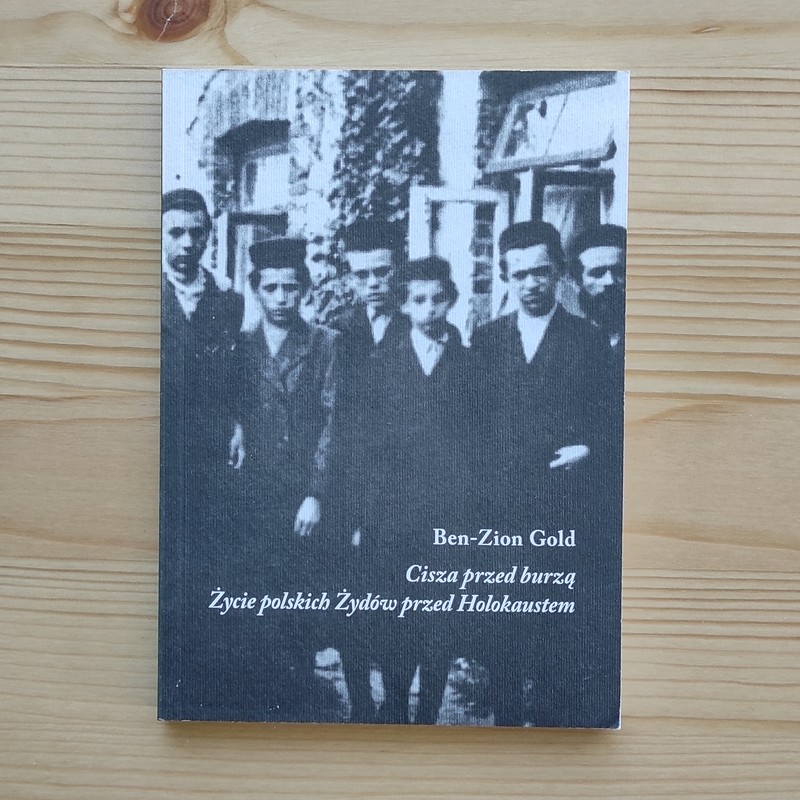
Ben-Zion Gold
Cisza przed burzą: życie polskich Żydów przed Holokaustem, 2011
(tłumaczenie, redakcja i przypisy Joanna Preizner)
Czytając Ciszę przed burzą. Życie polskich Żydów przed Holokaustem Ben-Ziona Golda wprost nie mogę uwierzyć, że te wydarzenia miały miejsce w Radomiu, mieście, w którym wtedy mieszkałem. To prawda, Autor jest nieco starszy ode mnie, ale jego świat nie styka się z moim w żadnym punkcie – ani w szkole, ani w kościele, ani w harcerstwie. Nawet opisane ulice są mi znane tylko z nazwy. Co ważniejsze, ten świat jest niezwykle poważny, a rozważania i wybory tego nastoletniego żydowskiego chłopca są rozważaniami i wyborami dorosłego mężczyzny…
Andrzej Wajda (ze wstępu)
*
Pamięć o europejskich Żydach została zdominowana przez Holokaust. Napisano o nim tysiące książek, ale tylko kilka o tym, jak żyli polscy Żydzi, zanim ich zamordowano. Holokaust był niewątpliwie największą tragedią w żydowskiej historii. Jest jednak błędem traktowanie go jako jedynego jej dziedzictwa. Jest nim bowiem przede wszystkim to, jak żyliśmy i co zdążyliśmy zbudować przed Holokaustem – bogata literatura religijna i świecka, muzyka chasydów i klezmerów, żydowskie piosenki, sztuka. O różnorodności żydowskiego życia w przedwojennej Polsce świadczy ogromna liczba gazet i czasopism wychodzących w dwudziestoleciu międzywojennym w jidysz, po polsku i hebrajsku. Niezamożni polscy Żydzi wydawali więcej dzienników i periodyków niż znacznie liczniejsi i bogatsi Żydzi amerykańscy. Ta kulturowa i religijna spuścizna zasługuje na pamięć potomków zamordowanych Żydów europejskich. Moje wspomnienia opisujące tradycję i obyczajowość mojej rodziny i całej żydowskiej społeczności, w której dorastałem, są może małą, ale istotną częścią tej pamięci.
Ben-Zion Gold